The Problem Today
Our urban environments are far from ideal. Let's have a look at the current gaps, solutions, and opportunities for improvement.
Modern life, our needs unmet
Frequent interaction with nature has psychological and physical benefits. We evolved within nature, understanding its patterns and seasons, and created gardens as a village resource, the foundation of our agrarian civilisation.
The loss of backyards means many urban dwellers have lost daily interaction with nature. Sure, we may see a handful of trees through our windshields, on our way to glass-clad office buildings. Or maybe we do live near a park, but it’s just another overheating patch of lawn. It’s not quite the same.
For anything more natural and meaningful, we often have to travel further out, which requires effort, time, and money. This is already an obstacle for the average exhausted urban worker; furthermore disproportionately affects our most vulnerable, who do not have the agency or physical ability to travel. Children turn to devices. The disabled and elderly become trapped in their homes. Workers stay stuck in the home-commute-office loop. Everyone misses out on the benefits of the outdoors.
That's why we need diverse, interesting, and exciting urban green spaces, to incentivise people to go outside every day, and meaningfully connect with nature.
It becomes a mutually supportive relationship: the more people enjoy and understand nature; the more they will respect and take care of it.
The loss of the backyard
Urbanisation has changed how we live.
We’re well past the era of the suburban dream, where every family owns a detached house on a quarter acre block. While it’s still a cultural sore spot, this departure is a welcome change. Aside from being incredibly damaging to the environment, the suburban lifestyle is deeply insular and socially isolating (in a thin facade of wholesome family self-reliance).
People are increasingly living in apartments and units; blocks are shrinking, developers prioritising mid- to high-rise residential buildings. As a consequence, backyards are disappearing, and balconies are shrinking.
Densification isn't a bad thing, it is absolutely necessary to accommodate growing populations and avoid environmentally-damaging sprawl. But density needs supporting infrastructure to maintain the wellbeing of the people who live there.
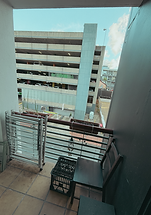

Inspiring scenes from my inner-city balcony

Urban loneliness
Our urban spaces are home to the vast majority of the population. People are living closer together, but proximity alone doesn't necessarily lead to social wellbeing.
"Social atomisation is increasingly resulting in single-person households and isolated people. Collective forms of activity, of whatever stripe, are hampered by time scarcity, a strong tendency towards online interaction, and spare time that is often spent indoors."
- Oliver, 2024
With dwellings getting smaller and losing their outdoor space, it becomes more difficult to host friends and events. A studio apartment gets crowded fast.
Our only option becomes to hang out outside the home, which in an urban setting, usually involves spending money - restaurants, bars, etc. When that precious resource becomes scarce, like in a cost-of-living crisis, people choose to stay home, alone.
Our late capitalist society relies on social isolation, environmental extortion, and complete reliance on disembodied corporate entities. It doesn't have to be like this.
In this time of increasing isolation, we need more third spaces that can be used in a variety of ways by a variety of people. We need welcoming, free-to-use public infrastructure that meaningfully brings people together.
“Gardens offer positive distraction from the ‘white noise’ of modern life, from the information overload that comes from digital media, from physical pain and mental suffering.”
- Souter-Brown, 2015
The current solutions aren't enough.
Let's cool it with the turf...
Here in Australia, our cities have many parks and “green” spaces scattered throughout urban areas.
Looks great on paper, but in reality, most of these provide very little ecological or community value.
Take a wander around on satellite maps and you’ll quickly notice that basically every public open space is covered in the same plant: turf grass. Parks and ovals are the obvious, but this plant has also taken over every interstitial space: roundabouts, the median strips between roads, the gaps between ovals, parks, and playgrounds.
Turf has some benefits, of course. It’s sturdy, and great for unstructured play, sports, walking the dog, group events, markets and festivals, open air gigs.
But its downsides are undeniable.
-
High-maintenance and thirsty
-
Shallow root system leads to soil compaction, reduces deep water infiltration, and worsens overland flow and flash flooding issues
-
Invasive growth pattern dominates surrounding gardens, and leaves no room for variety in plant species
-
Provides little food and habitat for local wildlife
-
Frequently maintained with herbicide and pesticide sprays that affect our native vegetation, wildlife and groundwater
-
Fast-growing: mow it down, and it will grow right back in two weeks time. If you’ve ever lived near a public park, you’re familiar with the constant noise of a ride-on mower (which is also guzzling fuel or electricity as a bonus)
Once you start looking, you'll see just how pervasive it is. Let’s take a quick flight over inner-north Melbourne:

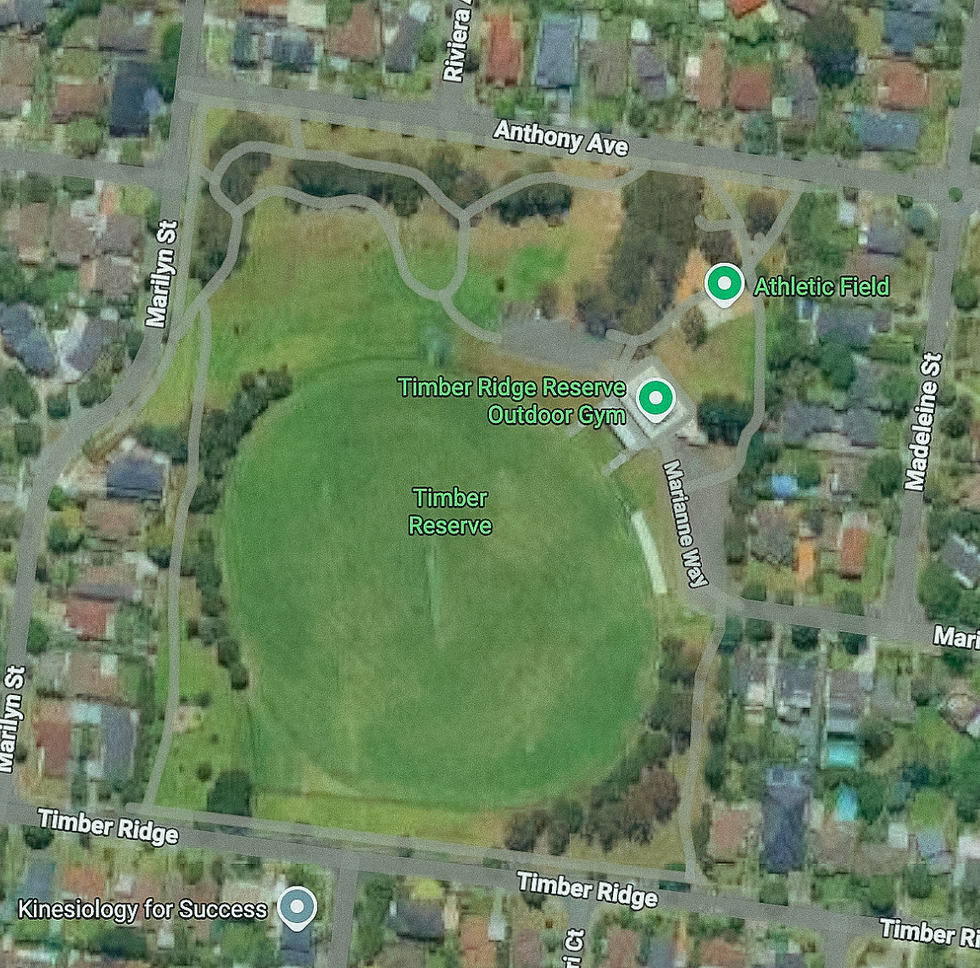


Everywhere you look, turf.
Can you imagine how much work it takes to maintain all of this? How much it costs to mow and spray every two weeks? I don’t want my taxes to go into an endless loop of lawn maintenance, I want them to go to something that actually allows us to experience the joys of nature.
Not every open space needs to be turf.
Many of these spaces are currently underused, and have the opportunity to become better green spaces.
BACKYARDS can still provide all the functions needed from local pocket parks - play, picnics, dogwalks, mental health walks - while adding much more variety to the activities, scenery, sensory experiences. Gardens that are tailored to their communities, that encourage people to connect with nature, and with each other, in a more meaningful way.
It's especially needed in our increasingly hot climate, an open lawn with no shade becomes virtually unusable in the warmer months. Creating more diversity with layered vegetation, trees to shade seating areas, ponds for cooling, will make these spaces much more thermally comfortable, and significantly improve the amenity and use of these green spaces.
Instead of littering our cities with underused, hot, boring patches of grass, we can bring a lot more life and fun to our urban green spaces.
Let’s keep the lawns where they’re actually needed - sports ovals, event-hosting parks, etc - and allow everything else to become a little bit more natural, more environmentally meaningful and comfortable.
What about community gardens?
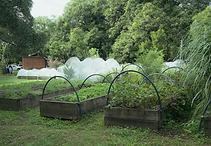
Community gardens are fantastic.
They bring people together through a shared love of gardening, and encourage community connection through shared resources. They give people agency, self-determination (within the group’s jointly decided rules), and encourage mutual respect and responsibility.
Despite these benefits, community gardens have a significant limitation:
since they are funded and run entirely by the community, they require high time and labour investment from members.
If you're not familiar with how they operate: a small group of dedicated community members come together, identify a plot of land they would like to garden, and negotiate a land use deal with the local council. Once approved, the group decides on a garden design, establish shared rules and responsibilities, and build the gardens together. From then on, members care for their own garden plots, follow their volunteer commitments, and attend management meetings.
It takes a lot of commitment, time and work.
Consequently, most people involved in community gardens are the folks who have plenty of spare time. They are inaccessible to the majority of our grinding, time-poor society: students, parents, carers, workers.
When the average person is working or studying 8 hours a day, commuting for an additional 1-2, while keeping the house clean, cooking meals, planning for the week ahead, remaining active and healthy, making time for friends and family, caring for kids or pets, trying to squeeze in hobbies, self development, rest, and mental wellbeing… How could they even consider committing to a weekly volunteering schedule and management meetings? Or even taking the time to learn enough about gardening to keep their own personal plot? Aside from time, what if they aren't physically able to care for their own garden, or to partake in shared responsibilities?
The demand for time and labour from an already overworked population discourages people from participating in these communities in the first place.


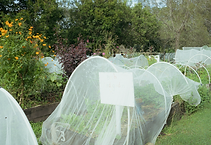

BACKYARDS is proposed as an additional, accessible alternative.
Accessibility is key. Gardens shouldn’t be exclusive to the able-bodied and time-rich. They should be accessible to everyone, enriching our lives, welcoming us to connect with each other and with the land we inhabit. Everyone should feel the joy of a beautiful garden; to be able to walk outside, grab a fresh fruit off a tree, sit in the shade of a tree, and take a moment to breathe.
To meaningfully improve our daily connection with nature, we need to integrate sustainability into people’s daily lives with ease:
“It is difficult to live a healthy lifestyle without an appropriate environment. Healthy choices, whether meeting friends in the park, eating fresh fruit or cycling to school have to be the easy option.”
- Souter-Brown, 2015.
By making these spaces free to use, and maintained by Caretakers, they become accessible to so many more people. Everyone can enjoy community, food and nature at their own pace, without the daunting demand for time, money, and volunteering commitments.
Our governments are responsible.
Just like any local park, library, or community hall, BACKYARDS would be government-funded.
Our local governments are committed to creating vibrant communities, supporting health, arts, events, environment, and this is no different. They have the responsibility to care for the land they manage, and to serve their communities' needs.
We’re in this situation because our public spaces have not been prioritised. Subservience to lobbyists and developers, lukewarm environmental policy, and downright inept urban planning. The people have not been put first. We have not been properly consulted on what we want from our parks, and have no direct say in how our land care taxes are allocated.
This is a matter of government responsibility. Good land management and provision of green amenity is not only essential for personal wellbeing, but also for our society's health and economic performance.
I've pulled a few quotes from Souter-Brown's 2015 book that encapsulates this perfectly:
“If governments, housing providers and educators are to be socially and economically accountable, environmental quality and the widespread provision of healing green space must be of major interest and concern.”
“When we talk about healing gardens having the capacity to heal communities it is about providing spaces where anyone can freely access a healthy, active lifestyle. [...]When people are attracted to spend time outdoors daily in nature, multiple benefits spill over into the community.”
“A healthy, active lifestyle is the basis of most public health promotion programmes around the world. With a shrinking tax base from an ageing and increasingly disabled population, governments need to find new ways to keep people healthy and in the community as long as possible. As the pace of urbanisation and climate change increases, governments are under pressure to supply liveable towns and cities. A salutogenic design approach creates an environment that is nurturing and healing. Encouraging and enabling healthy behaviours using evidence-based urban design makes social, environmental and economic sense. Using landscape interventions to adopt a preventative approach will create a healthier society and place lower demands on struggling healthcare systems.”
The benefits of something as simple as better green spaces will spill over into all areas of our society and economy. This is of immediate interest not only to us as people, but also to our governing bodies. We are well within our rights to demand more from our tax-funded urban green spaces.
Unpacking government funding
Undoubtedly, from initial setup to ongoing operations, the cost of BACKYARDS will be higher than the cost of mowing lawns every couple of weeks. However, it's clear the social and ecological benefits are worth the extra cost.
Every BACKYARD will have a different cost, depending on their size, facilities, local suppliers, etc.
Government funding needs to cover the installation of gardens, construction of facilities, and Caretaker salaries. The funding will need to be determined by councils per location, but I've included a ballpark in the 'Getting Started' section.
Let's review the current budget allocations in the City of Melbourne Budget 2025-2026 to get our bearings:
Here, the green space budget is broken into:
-
"$44.3 million will be spent on new works. The more significant projects include [...], pocket parks and reserves ($3.1 million), public art ($3.0 million), streetscape improvements ($3.0 million)"
-
"$56.1 million will be spent on renewal and refurbishment of existing assets. The more significant projects include [...] parks renewal ($5.7 million), [...] tree planting and replacement ($2.1 million)”
-
“$400,000 has been allocated to extend the Urban Forest Fund so we can grow a greener Melbourne together.” “There have been five rounds of grants offered since the Urban Forest Fund was established in 2017, totalling over $3.2 million in funding.”
-
“$2.7 million to build on the success of pocket parks like Bedford Street in North Melbourne.”
-
“$7.1 million provided by the Victorian Government to be spent on parks and open spaces, roads and community facilities projects.”
-
“$4.1 million will be allocated to the development of existing public open space reserve projects, to be spent on:
-
Pocket Park Program
-
Parks Renewal Program
-
Chelmsford St open space
-
Normanby Road Reserve expansion
-
Chapman Street Pocket Park
-
Miles and Dodds Street Reserve
-
Aside from local council funding, the Victorian State Government has also created the Pick My Park program, which offers $30 million for new and upgraded parks, based on community input.
The last round of funding ranged from $30,000-$250,000 per project.
Across city and state budgets, there is a significant amount of cash currently earmarked for green space management and improvement. We know a significant chunk of it isn’t being used to its fullest potential (how many lawns are included here?), and could potentially be directed to convert some of our parks into BACKYARDS.
The money is there. Let's put it to better use!
Setting a precedent
Only a local community can actually tell if their local governments are responding to their local needs. As a democratic society, we the people need to hold the government accountable for not fulfilling their end of the contract. BACKYARDS can set a precedent for urban green space legislation that puts community first.
Really... what other options do we have?
Hand the job over to a rich, 'trustworthy' corporation.
Corporations are inherently profit-driven. There will always be a vested interest in increasing revenue above other factors. We have no idea who is at the top of the pyramid, who is benefitting from what, or how many interested parties have dipped their fingers in the project. Many “nonprofit” organisations have been known to siphon donation money into questionable pockets. Do we really want to hand our wellbeing over to companies, when unregulated capitalism is what got us here in the first place?
Rely on community-organised, volunteer-led organisations.
Unfortunately, these also exist within a capitalist system (we all do). They require the personal investment of money, time, and effort from their local community members. As discussed earlier, this limits participation, access and influence to the resource-rich few. In addition, since these groups are headed by community leaders, they can struggle to maintain momentum with leadership changes, become troubled with infighting, and dissolve.
There are reputable and successful nonprofit community organisations that combine gardens, community, markets, and education; some notable examples being CERES in Melbourne and Northey Street City Farm in Brisbane. These places are fantastic and should be celebrated, but they still need to generate money to be viable (capitalism again). They charge for educational courses, produce markets, rely on donations and volunteer labour. Again, people who don’t have disposable time and income are invariably locked out, or at least limited in how they can engage with these spaces.
Sit around and wait for a good-hearted philanthropist billionaire to selflessly buy large tracts of land to convert into wildlife reserves and regenerative urban agroforestry free for community enjoyment.
… Come on. Who are we kidding?
Obviously, governments can be corrupted just like corporations can. But that doesn’t mean we turn away and ignore them - the popular response of resignation, defeat, expecting the worst, only makes it easier for incompetence and corruption to slide by unnoticed. Politics affects every one of us. If we don’t demand better, if we don’t hold our governing bodies accountable, we’re beyond screwed.
We need to start by changing the system. There is no deus ex machina that magically fixes everything and saves us all; that’s not how realistic and meaningful change happens.
Take small steps; speak to your neighbours; reach out to your councils; improve your local parks; eventually we can look back and realise the system is no longer what it used to be.
Nothing proposed here is unprecedented: this is an attempt to synthesise existing concepts into something cohesive and effective. I've kept the background information light, but linked some of my favourite resources in 'Extended Reading' if you'd like to delve deeper into principles of landscape architecture, the impact of environmental degradation on global health outcomes, healing garden design, preventive approaches to public health and wellbeing, community resilience, etc.