Connecting to Community
The point of BACKYARDS is to connect communities to themselves and to nature. We can be intentional about that.
Tailoring to community needs
To make useful, beloved BACKYARDS, we need to start by understanding what the community actually needs. Community consultation should include activities - how people would like to use the space, what's missing from their local area, what would help support their passions.
The design of the landscape and facilities should then be tailored to suit these needs.
Examples of activities
-
Repair and upcycle workshops
-
Share/swap/trade markets
-
Shared meals
-
Cooking workshops
-
Classes
-
Art & craft workshops
-
Art exhibitions
-
Live music
-
Instrument classes
-
Movement classes
-
Dance or theatre performances
-
Film screenings
-
Book readings
-
Badminton/pickleball
Extra facilities
-
Woodworking workshop
-
Bike repair shed
-
Book library
-
Tool library
-
Pantry (preserves, teas, herb mixes, etc.)
-
Art gallery
-
Outdoor kitchen
-
Music/theatre stage
-
Dance studio
-
Swings or hammocks
-
Sports nets
-
Projector movie screen
The local composting hub
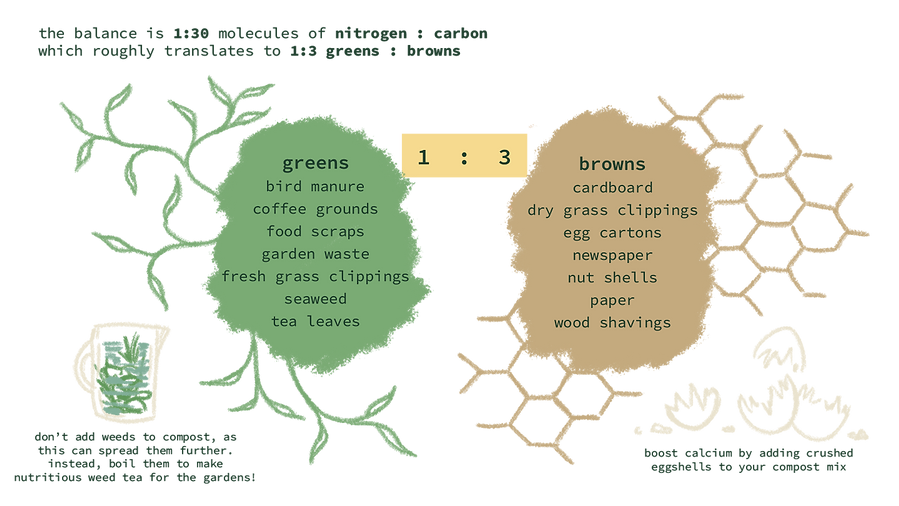
Compost is the best fertiliser. Rich in nutrients, broken down to a composition readily accessible to plants, adding organic matter to support soil health. It's how waste becomes life.
Community composting hubs help close the consumption loop at the local level.
They're a great way to get the community involved, and to educate people on how we can reduce waste and take care of our land at the same time. Then the compost goes into the gardens, fertilising a new crop of food for everyone to share.
Local residents can bring their home food scraps.
This encourages them to visit the gardens more frequently, and saves their wheelie bins from the summer stink.
Local businesses can bring their commercial waste.
Reducing their waste fees, while contributing to the fabric of their community.
Integrating education
Sharing food, third spaces, and event facilities is a how we start supporting the community.
Sharing knowledge is how we start empowering the community.
By integrating education into the BACKYARD, we can increase people’s appreciation for their local environments, food sources, and the complex dance of nature. We can encourage people to care for their own gardens, to try new foods, to spend more time outside.
Knowledge gives people the confidence to connect with nature.
Workshops
Workshops and educational activities are a focused way to share knowledge and upskill the community.
These could be hosted by Caretakers, local community members, professionals and educators. They could cover any range of environmental subjects, from gardening, to natural dyeing, to sustainability and conservation.
Educational signage
Signage allows people to explore the gardens and learn at their own pace, without having to book a workshop in advance. Signs should be placed throughout the gardens, explaining the purpose of different elements - compost, rainwater, plants, ponds, logs, etc.
Food information signs are particularly important since food can be harvested by anyone, at any time.
They need to include:

These signs could be made by keen community members - a workshop to paint the signs would be a great way to get the community involved right from the get-go. Everyone learns about the gardens together, makes their mark, and feels connected to the project.
Garden care events
Garden care events are a great way to bring the community together to get involved, care for their shared resources, and learn more about gardening.
Hosted by the Caretakers, these events could include:
-
Seasonal harvest parties
-
Seed collecting
-
Mulching musters
-
Making furniture/signage
-
Crop rotation
-
Community planning meetings
Access and exclusivity
Considerations to ensure the BACKYARD is accessible and responsive to its local community:
Extended operating hours
The gardens are open and accessible 24/7, but facilities and events need to be supervised by Caretakers. Having extended operating hours, captures both the early and late demographics, ensuring access to various members of the community - office workers, night shift workers, students, young families, stay at home parents, retirees.
Prioritising local hosts
The ability to book facilities should be limited to the immediate community (maybe a 1km radius).
This reduce external competition, uplifts the local community, fosters a sense of ownership and mutual responsibility for a shared resource, and ultimately creates stronger bonds between people and place. Attendees shouldn't be held to this limitation, only organisers.
Prioritising local services
Gardens and facilities should be designed and built by local professionals, materials should be sourced from local suppliers, signs and furniture should be commissioned to local craftspeople or made by the community. This reduces external competition, and stays more local and grounded than going to people who have no connection to the place.
Prioritising local Caretakers
Caretakers should be hired from the local community. Professional horticulturists, groundskeepers. Supporting local people and local economies.
Every BACKYARD should be brought to life by its community, which uplifts the community in return.
This exclusivity will cause FOMO for those outside these parameters - an additional push for councils to create more BACKYARDS. In an ideal scenario, there will be a BACKYARD within walking distance (<1km) of every urban household. A city grid of well-considered green spaces. This will allow each BACKYARD to be connected to its own place, people, community.
Trust and respect
BACKYARDS is open to everyone in the community. Everyone is welcome to enjoy the space, harvest the produce, participate in their community.
There will be a learning curve for the community. Many people have never interacted with a garden before, and will overdraw produce, accidentally damage plants, etc. Many are not used to sharing community resources, and might push back on management decisions, disagree with the use of space and facilities, or face more complex social issues like discrimination. We should expect this to happen, and be prepared to deal with these situations with patience.
Building trust and accountability
-
Reach out to all members of community to initial project consultation
-
Develop location-specific community policies collaboratively
-
Invite all members of the community to ongoing community meetings
-
Maintain Caretakers presence throughout the day as passive monitoring and safe contact
-
Host events that encourage community participation
-
Ensure educational signage is visible and accessible
By coming from a place of generosity, sharing knowledge and resources, and welcoming participation, we can cultivate a sense of common responsibility. Rather than surveillance and punishment, the system should encourage mutual trust and respect.